Rethinking Machining Sequence Logic
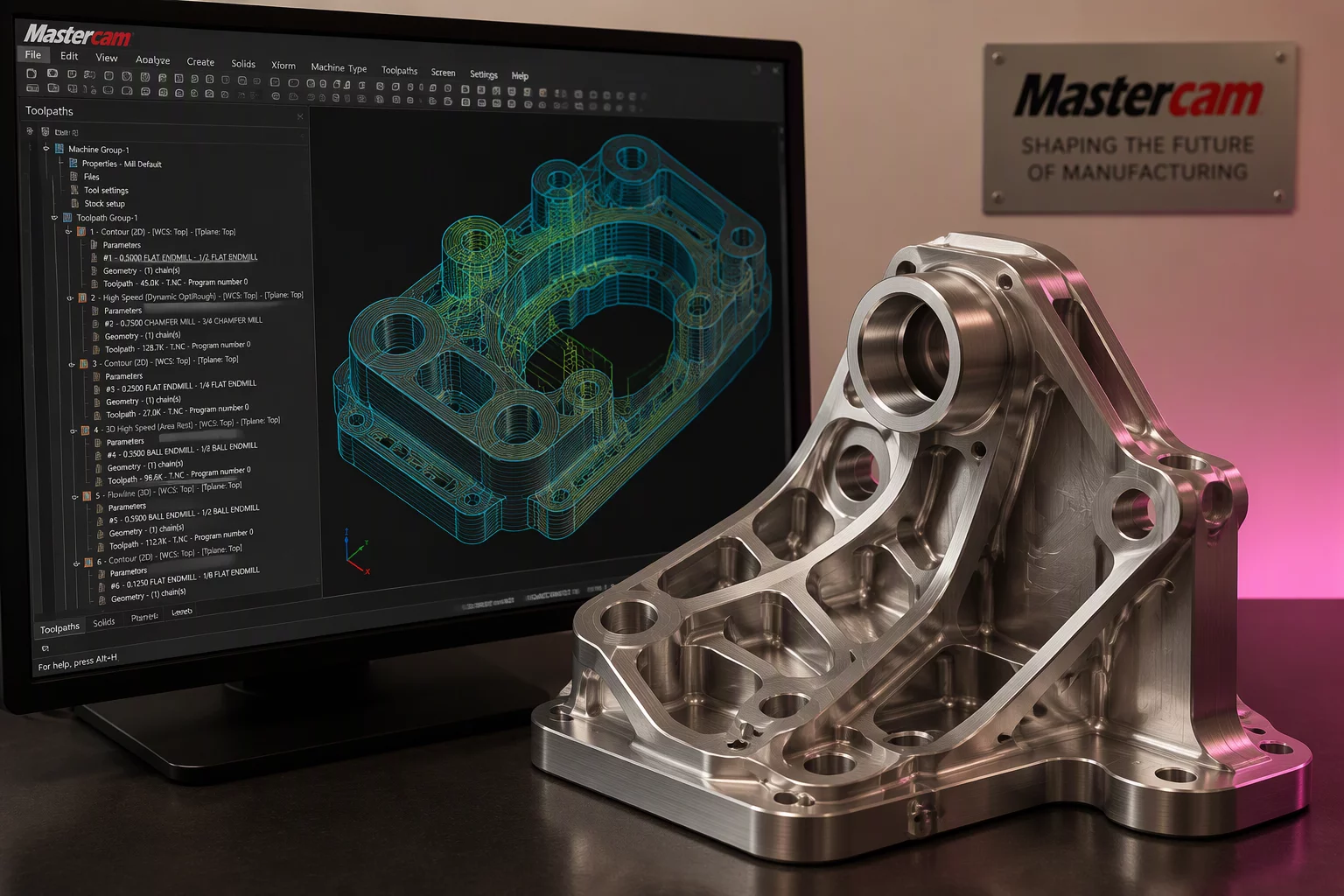
FeatureOrder Atlas is an open engineering initiative dedicated to decoding the structural interdependencies of CNC machining operations. By modeling geometry transitions and toolpath hierarchies in Mastercam, we eliminate chatter, deflection, and redundant cycle times.
The Deterministic Order Paradigm
Traditional CNC programming often treats 3D features in isolated batches: roughing out material, facing datums, and drilling hole patterns arbitrarily. When machining thin walls, tight pockets, and critical bearing bores, the sequence in which workpiece rigidity is removed dictates dimensional accuracy and residual stress.
Our Feature Order Map establishes rigorous precedence graphs for Mastercam toolpath trees. The framework guarantees that high-deflection areas retain structural bulk until final finishing stages, minimizing fixture reload cycles and preventing workpiece distortion.
Feature Order Dependency Matrix
Select a prismatic or 5-axis feature below to inspect its mandatory predecessor operations and Mastercam toolpath restrictions.
Initial primary datum generation ensures Z-plane alignment before high-volume cavity clearing.
Constant engagement angle and micro-lift retraction prevent chip re-cutting during pocket entry.
Surrounding bulk material supports bottom floor rigidity; execute prior to wall thinning.
Systematic Analysis in Mastercam
Our laboratory systematically isolates four interdependent variables governing CNC machine program efficiency.
Geometric Precedence
Determining topological boundaries where cutting an upstream geometry alters the fixture clamping stability for downstream operations.
Toolpath Tree Architecture
Structuring operation groupings, tool changes, and transform planes inside Mastercam to shorten rapid non-cutting positioning times.
Deflection Balancing
Modeling the dynamic compliance of thin-walled aerospace and industrial ribs when submitted to high feed rates and side tool loads.
Cycle Time Optimization
Synthesizing multi-tool sequencing algorithms to systematically trim air cuts and unnecessary spindle speed adjustments in production.
From 3D CAD to Validated CAM Sequence
Follow the three-stage roadmap employed in FeatureOrder Atlas to systematically order and verify CNC toolpaths.
Topological Feature Decomposition
Solid CAD geometry is parsed into boundary features: plane datums, open steps, blind pockets, bores, and fillets, identifying all shared boundary edges.
Precedence Matrix Generation
Rigidity and accessibility relationships form a directed graph in Mastercam. No finishing passes are approved until primary roughing stress is relieved.
G-Code & Kinematic Verification
The sequence is simulated against multi-axis machine kinematics to verify zero toolholder collisions, optimized tool changes, and smooth axis transitions.
Explore Mastercam Operation Cases
Dive into our exhaustive library of feature sequencing case studies, benchmark data, and toolpath trees designed for modern CNC production.