 CAM Sequence Map
Sequence C: Setup Relationship Blueprint
Sequence C organizes machining operations strictly around datum hierarchy and setup relationships. By resolving parent datum finishing before initiating child feature roughing or finishing across multiple orientations, this strategy eliminates tolerance stacking, minimizes workpiece flexure during re-clamping, and ensures consistent geometric dimensioning across coordinate systems.
Download Setup Blueprint & CAM Sequence Notes
Datum-Driven Grouping
Sequences features according to reference surface establishment, guaranteeing all downstream coordinate systems rest on qualified physical datums.
Re-Clamping Rigidity
Prevents deep pocket or wall thinning operations prior to high-force clamping in secondary setups, maintaining structural workpiece stiffness.
Multi-Axis Machinists
Designed for CNC programmers managing 4-axis tombstone and 5-axis trunnion workflows where feature relationships cross multiple coordinate work offsets.
Unsure Which Sequence Fits Your Part Geometry?
Compare tool-grouped, depth-grouped, and setup-grouped toolpath paths with our sequencing team.
Architecture of Setup-Relationship Feature Sequencing
When programmers prioritize tool change reduction over setup relationship logic, subtle dimensional errors creep into multi-sided components. Sequence C establishes a rigorous priority rule: every feature that acts as a locating datum or reference locator for a subsequent setup must be completely machined, inspected, and deburred before operations on dependent features commence. In complex 5-axis or multi-op vertical machining, cutting a dependent slot or boring an internal diameter before finishing the primary mounting face forces subsequent setups to locate on raw stock or unstable semi-finished geometry. By grouping toolpaths by setup relationship, programmers guarantee that every coordinate rotation and part flip relies upon mathematically pristine planar and axial datums.
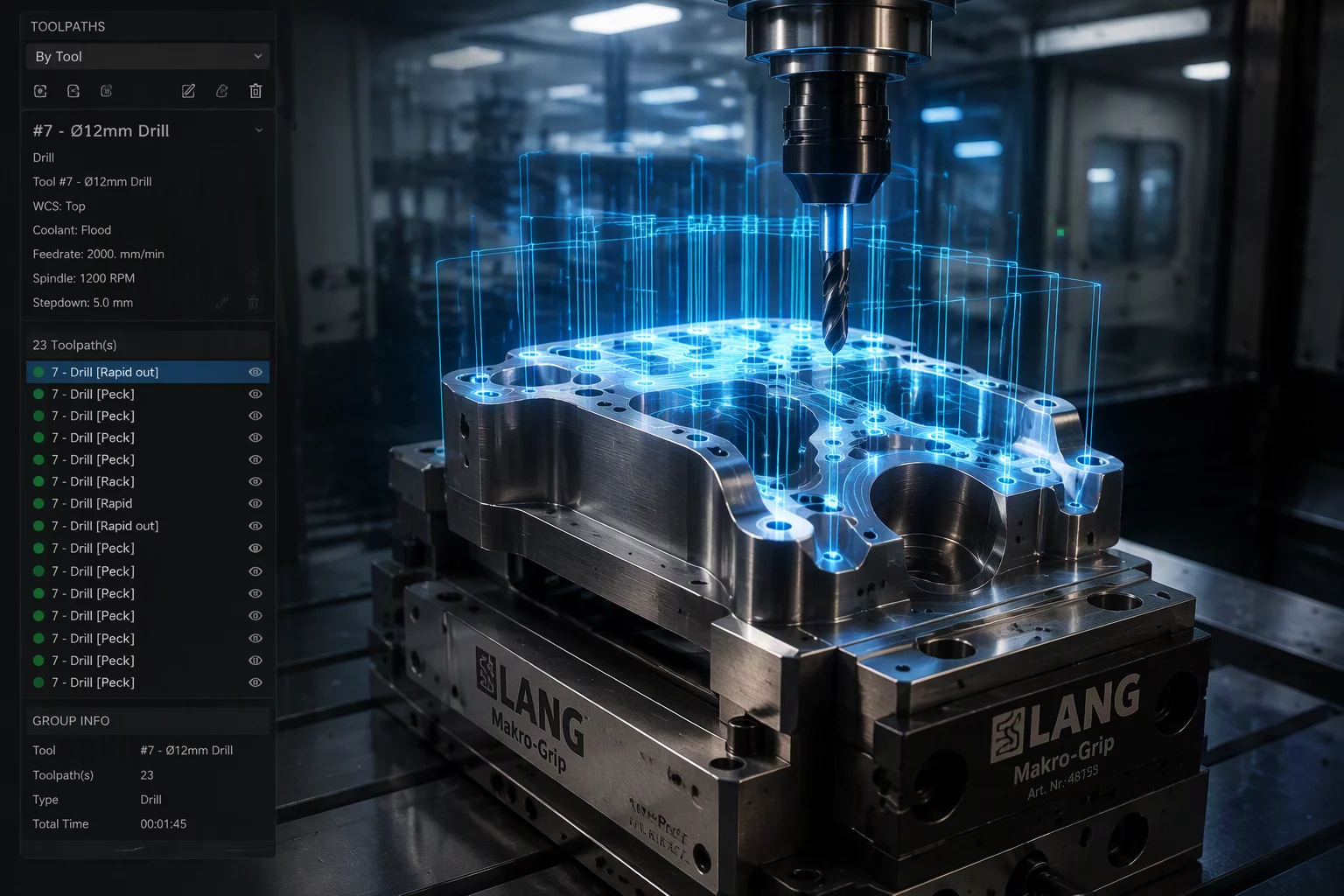
Workpiece stiffness also dictates setup sequencing. Removing massive volumes of material during an initial roughing pass can release residual internal stress, distorting the part prior to critical datum cuts. Sequence C separates bulk clearing from datum finishing and synchronizes secondary setup transfers with structural rigidity thresholds. In modern Mastercam 2026 workflows, programmers utilize GPU-accelerated simulation to verify fixture clearance, gauge tool reach across rotational planes, and evaluate how cutting loads in secondary setups act against previously cut voids. Grouping by setup relationship ensures maximum stock remains under clamp contact pads, avoiding chatter and preventing thin-wall deformation during heavy dynamic milling passes.
Key Implementation Principles in Sequence C
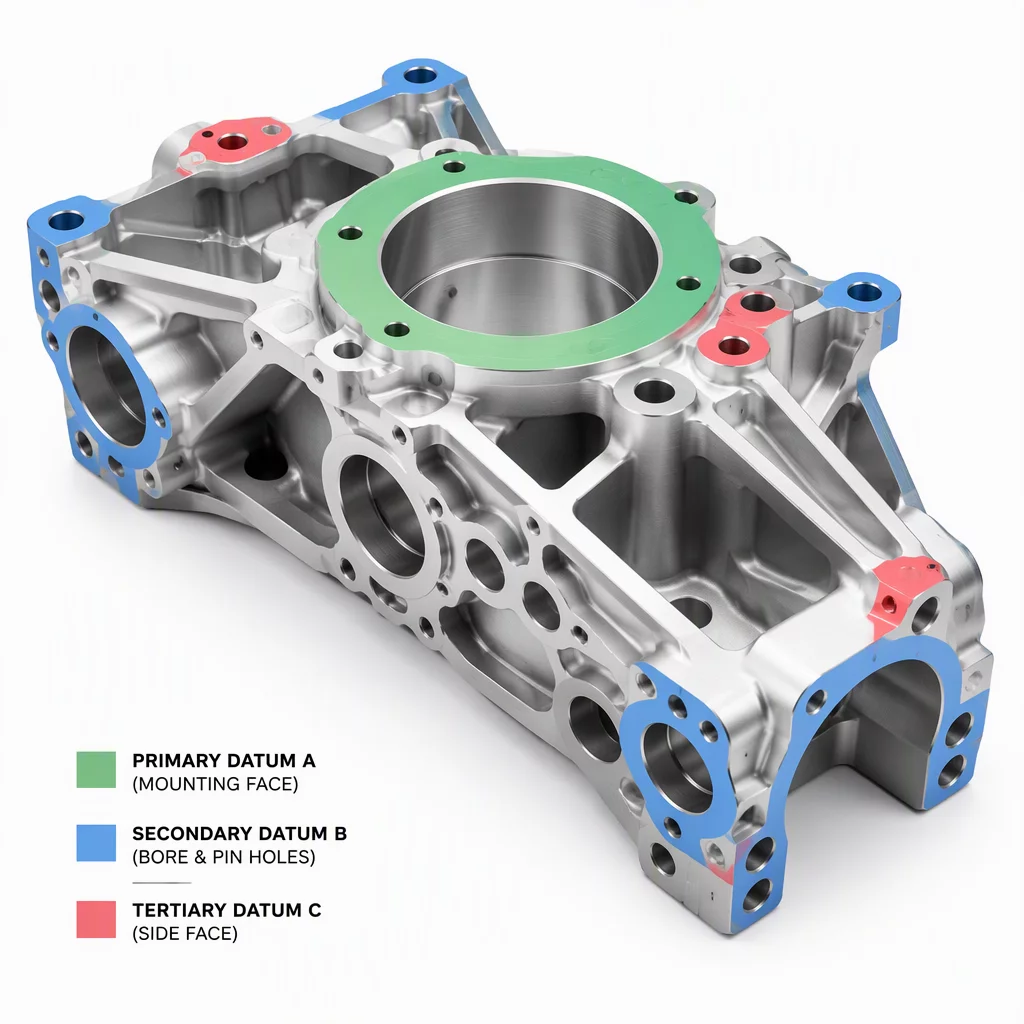
- Machine primary datum planes A, B, and C in Op 10 before initiating non-critical clearance pockets.
- Finish secondary locating dowel holes and clamping surfaces while the raw billet retains maximum rigidity.
- Transition to Op 20 work offsets only after verifying datum contact points against simulated fixture jaws.
- Sequence stress-relieving roughing passes prior to final datum skim cuts to negate material distortion.
Technical Specifications & Sequencing Logic
Engineering parameters governing the Sequence C setup relationship model in production CNC machining environments.
| Parameter | Engineering Value | CAM Rule Context |
|---|---|---|
| Datum Dependency Order | Primary (A) -> Secondary (B) -> Tertiary (C) | Strict hierarchical sequencing preventing child coordinate offset drift. |
| Clamping Force Allowance | > 18.5 kN on Raw Stock / 6.2 kN on Finish | Heavy roughing confined to primary setup where stock volume supports high vice torque. |
| Work Offset Synchronization | G54 -> G55 / Dynamic WCS Planes | WCS matrix translation linked directly to machined datum features from preceding setup. |
| Simulation Verification | Mastercam 2026 GPU Mesh Engine | Multi-axis kinematic verification ensuring zero collision with secondary fixture clamps. |
Step-by-Step Setup Optimization Guidelines
Establish Datum Surfaces Early
Face the primary locating face and bore the primary locating dowels before roughing internal pockets. This maintains maximum part mass during datum creation, eliminating deflection caused by thin-floor flexure.
Evaluate Secondary Fixture Contact
Verify that clamps in subsequent operations land exclusively on finished surfaces or sacrificial clamping tabs. Never apply high-pressure hydraulic clamping to features whose walls have already been finished to final size.
Related Feature Order Strategies